
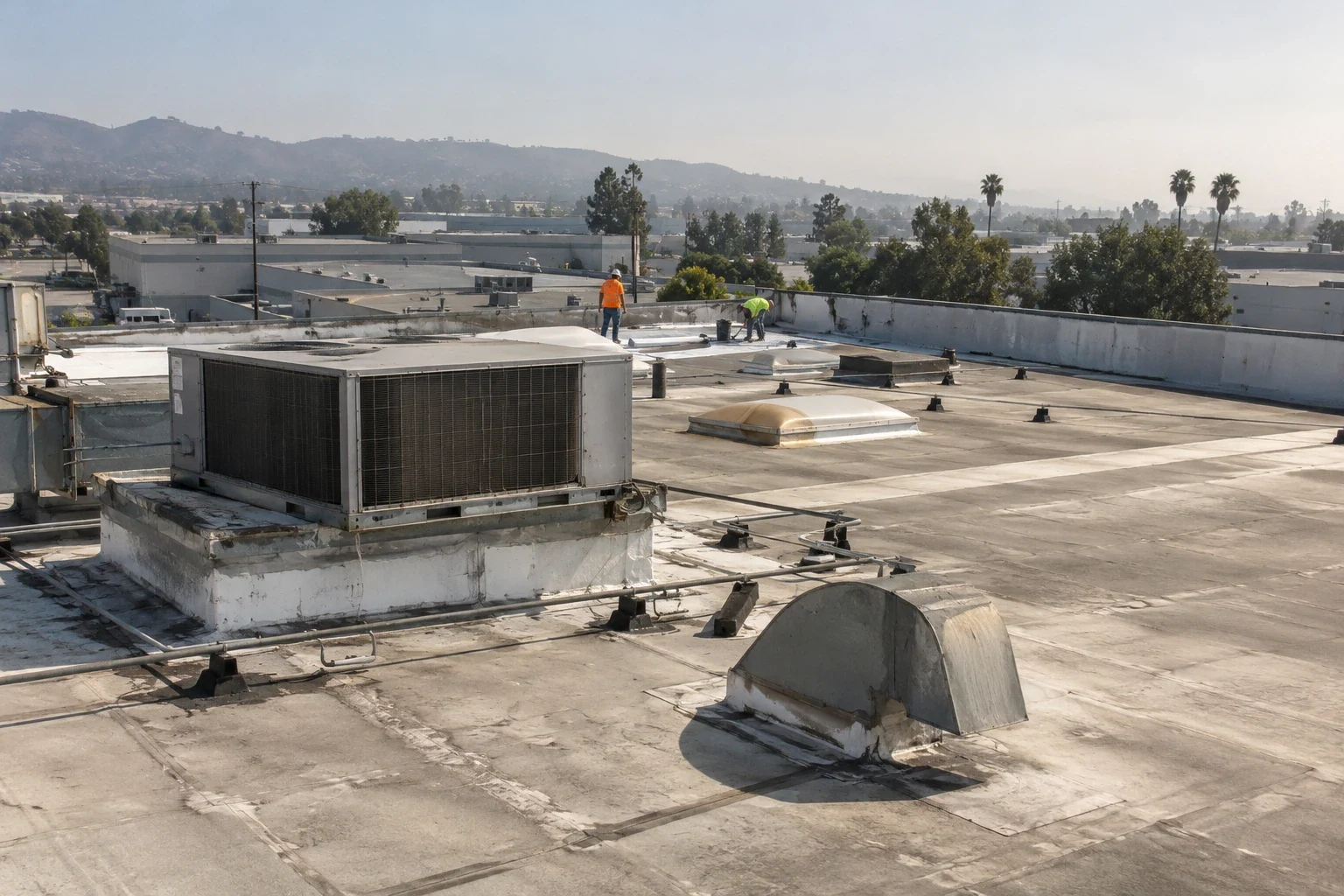
Roofing for Manufacturers in San Mateo, CA
CATEGORY
Industries We Serve
LOCATION
San Mateo, CA
A production roof has to protect the process below it while maintenance work moves through a real operating schedule. We inspect the assembly, identify active penetrations and equipment interfaces, then map repair or replacement phases around the plant’s approved controls. San Mateo’s business mix includes technology and finance firms alongside restaurants and retailers. That variety makes consistent plant records useful, while a roof survey still needs to confirm the actual assembly and equipment layout. Those facts describe the city’s business mix, not a particular plant. The facility survey and operating team supply the details that shape the roof scope.
Process map: mark what must remain available
Before a crew steps onto the roof, operations staff identify air intakes, exhaust, production equipment, utility paths, sensitive rooms, and any unit that requires an approved shutdown. We carry those locations onto the roof plan and mark where a work zone can be isolated. This helps distinguish a roofing task from work that requires an equipment contractor or facility engineer. A cover-board and insulation review can check whether the assembly supports the intended work without blocking equipment access. If a production line changes or a new conduit is installed, revise the roof map before pricing a nearby repair. The plan should make the building’s active constraints visible rather than rely on a verbal handoff.
Failure diagnosis: trace water without stopping at the stain
Water can travel along a deck, insulation joint, conduit, or structural member before it shows inside. We use the interior report to select an inspection area, then check laps, penetrations, curbs, transitions, edge metal, and drainage. If the source remains uncertain, we define a test opening and restore it in the same documented scope. A moisture survey may help prioritize where to test when approved conditions support the method. We do not use a thermal image as a standalone diagnosis. The final report identifies confirmed damage, suspected extent, and the next observation needed. A plant manager can then decide whether to isolate one zone, coordinate a trade, or plan broader renewal.
Penetrations: coordinate roofing with plant equipment
A replacement curb, pipe support, or exhaust change affects more than the roofing membrane. Confirm dimensions, load information, equipment clearances, and trade responsibility before altering the existing detail. We inspect the substrate around each penetration and specify compatible flashing that can be maintained. Where a unit must move, the work sequence should say who disconnects, lifts, resets, and verifies it. A rooftop support scope can isolate the roofing detail from equipment work so bids can be compared accurately. Keep temporary protection in place until the final tie-in is inspected. That prevents a new curb from becoming a hidden path for water after the roof crew leaves.
Local exposure: use the design criteria at the correct level
The city lists a basic wind speed and climate zone for code design, and it applies adopted building standards to permit work. We check the governing code, project drawings, attachment requirements, edge conditions, and any structural review before selecting fastening or perimeter details. When a facility is near US 101, record the confirmed approach, turning clearance, and unloading area before scheduling a material drop; regional road access does not replace the plant’s own delivery rules. A Mariner’s Island area visit can be arranged around the property’s confirmed route and operating window. Site exposure and code criteria should be evaluated for the actual building, not inferred from a business district.
Work window: divide the job by risk and release point
A sound phasing plan sets the amount of roof opened, temporary dry-in expectation, inspection hold point, and person authorized to release the next area. Production may continue below one zone while another is protected, but the facility decides whether that separation is acceptable. The scope should identify high-noise tasks, material lifts, equipment downtime, and controls that cannot be interrupted. A phased reroof plan can convert those requirements into daily limits and notice points. If rain risk, concealed damage, or production change alters the sequence, we record the new boundary and obtain approval before the crew advances. That keeps the schedule tied to field conditions rather than an optimistic area-per-day estimate.
Closeout: leave maintenance with a usable roof history
At completion, give the plant engineer a current roof map, photos of penetrations and terminations, material submittals, drain observations, and any remaining repair item. Label repaired areas so future inspections can distinguish them from original construction. Note where equipment work occurred and whether a separate trade owns a remaining adjustment. A logistics facility roof program can benefit from similar zone records, while manufacturing plans must preserve the plant’s own operating controls. For properties near Bay Meadows, confirm building-specific access before a future visit. A clean handoff gives maintenance a starting point for routine review and lets the next capital decision use the field record. Where roofing intersects a wider build, general contractor coordination can assign equipment, deck, and tie-in responsibilities before the roof opens.
The plant’s maintenance team should be involved before the roof scope is frozen. They can identify equipment that has been relocated, penetrations that no longer serve a process, and access paths that are missing from older drawings. We reconcile that information with the roof surface, then mark details that need a trade decision. A future unit replacement may require curb enlargement, new blocking, or a different flashing termination; capture that work while the assembly is accessible. If the roof is scheduled during a shutdown, define what can be completed before production restarts and what inspection point must be accepted first. A production manager can then set the handback around equipment testing rather than an arbitrary roof square count. Include material staging and debris removal in the sequence, especially where a service lane is shared. Record owner approvals and field changes by zone. That record makes the next maintenance inspection more useful because it shows where equipment work touched the roof and which details were intentionally left unchanged.
If production staff provide a planned maintenance shutdown, use it to inspect details that are otherwise difficult to access. Confirm the shutdown start and release time, lockout responsibility, and whether equipment can be tested before the crew restores the area. Do not assume a roof crew can isolate a process line. The plant engineer defines that authority. We can sequence roofing around the approved control and document the condition of the assembly before and after the work. Keep a list of spare membrane, compatible flashing, and repair locations with the facility record when those materials are part of the accepted closeout. This gives maintenance a better starting point for a future equipment change or leak report.
Commercial Roofing Questions
Can manufacturing continue while roofing work is underway?
The facility decides which operations can remain active below a work zone. We mark equipment, intakes, shutdown authority, and dry-in limits, then build a sequence for operations to approve before mobilization.
What should a plant provide before the inspection?
Share current roof plans, equipment locations, leak reports, access rules, and contacts for operations and maintenance. If those documents differ from field conditions, we mark the mismatch for confirmation before selecting a repair.
How are penetrations handled when equipment changes?
Confirm the unit or support dimensions and trade sequence first. We inspect the surrounding assembly, define compatible flashing, and record who resets the equipment and accepts the completed interface.
When does repeated repair become a replacement project?
Look for failures across several zones, wet insulation, weak attachment, deck concerns, and recurring service calls. We map the evidence and price alternatives so a plant can compare interruption and scope.
What belongs in the final maintenance file?
Keep a roof-zone drawing, photos of finished details, material documentation, drain observations, testing records, and open items. A clear file helps maintenance staff return to the exact area without guessing.
Review the roof scope with our crew
Share the property type, roof condition, access rules, and timing constraints. We can inspect the assembly, define a field scope, and coordinate a sequence around the operation.