
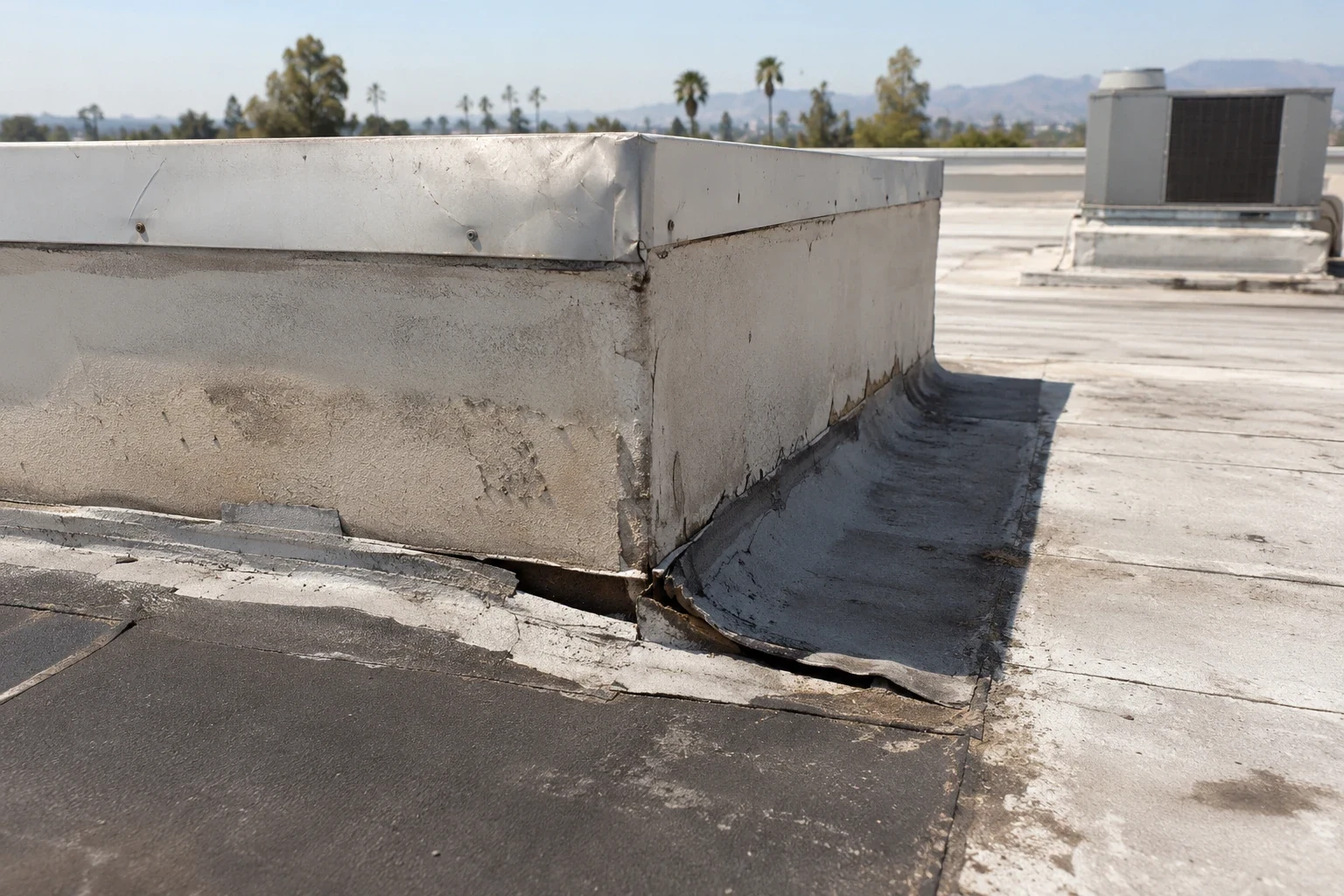
Flashing Failure Roof Repair in San Mateo, CA
CATEGORY
Roof Damage Repair
LOCATION
San Mateo, CA
An open curb termination can admit water while the field membrane looks intact. In San Mateo, CA, we trace the flashing boundary and mark where sound material can accept a tie-in. Downtown, Bay Meadows, and Mariner's Island bring different access and occupant needs, but each repair starts at the actual curb, wall, or penetration. The work order names the metal, membrane, and substrate included before removal begins.
Detail review: find the break in the flashing assembly
Flashing is a sequence of transitions. At a parapet, curb, wall, or pipe, inspect the membrane turn-up, termination bar, counterflashing, fasteners, and substrate. Lifted metal may leave membrane secure below; a cracked curb can let water behind sound metal. We photograph visible layers and note concealment. A penetration flashing repair may be separate at a pipe, skylight, or equipment opening.
San Mateo's code summary lists an 85 mph basic wind speed reference and addresses wind exposure. That makes attachment worth checking when metal shifts, but does not establish why a detail failed. We inspect the fastener line, substrate, profile, and membrane edge. If the deck or blocking is damaged, the proposal identifies the extra work before fastening to an unverified base.
At an occupied office, access above a tenant may be limited. We confirm roof entry, protection below, and whether equipment or another trade must move. A marked plan separates the failed curb from similar details that were not opened, keeping today's repair distinct from a larger project.
Water path: follow the path behind the metal
Water can pass behind counterflashing or within insulation before it appears indoors. Compare the stain with roof slope, seams, drains, and the detail, then check both sides. If staining remains after a curb repair, another opening may be involved. A leak investigation can map the affected area before flashing is rebuilt.
San Mateo's shoreline adaptation effort evaluates infrastructure and coastal-flood vulnerability, but does not identify a building's leak cause. Near Mariner's Island or Bay Meadows, we set the repair from the actual wall, curb, and membrane. District context helps with access coordination, not a claim about an individual roof.
At a curb seam, test whether the sheet is bonded to sound material. A seam repair may precede new flashing. A membrane puncture repair is separate when a fastener or sharp object has cut the sheet. We list each condition so a surface cover does not leave another water path open.
Scope boundary: write a tie-in that can be inspected
Name the detail, dimensions, preparation, metal, tie-in, and closeout check. Assign wall attachment or substrate repairs to the responsible trade. Do not cover loose or wet material to preserve a schedule. Agree on a stop point and temporary dry-in when concealed conditions prevent permanent closure.
The city's 2025 edition of California building standards took effect on January 1, 2026. Review may be needed when a repair changes an assembly or attachment. We separate an in-kind flashing correction from parapet reconstruction and identify design or permit questions for the GC. A narrow patch should not conceal structural or wall work.
Near Downtown, loading access affects where metal is staged. Bay Meadows has mixed-use planning areas, so confirm notices and work hours at the property. A Downtown San Mateo roof scope needs a site walk; a Bay Meadows repair should show access and tenant protection.
System detail: use compatible materials at each layer
Membrane type determines preparation and tie-in. TPO and PVC can be heat welded when the existing sheet is sound and clean. EPDM needs compatible primer and seam materials. Modified bitumen and built-up assemblies require different lap and surface preparation. Metal roofs add panel movement, clips, closures, and exposed fasteners to the review. We confirm what is installed rather than selecting a repair from the color or a past invoice alone.
At a curb, the new flashing must rise to an appropriate height, turn over the edge, and remain secure without blocking equipment service. At a wall, the termination and counterflashing should shed water without relying on a narrow surface bead to bridge an open joint. A TPO assembly or EPDM membrane requires the right compatible components. If the roof material is unclear, document the test or exposure used to confirm it.
Before the crew leaves, check the transition from the roof side and confirm that fasteners, laps, and sealant are complete. Record any area that could not be tested and schedule a follow-up observation after suitable weather. That note keeps the GC's closeout tied to the actual field work.
Handoff: close the detail without losing the record
Before the repair is covered, photograph the exposed substrate, prepared membrane, new termination, metal laps, and finished edge. Mark the curb or wall on the roof plan and record materials used. If the crew finds wet insulation, soft blocking, or a second failed detail, capture it and pause at the agreed scope boundary. The GC can then approve a defined change instead of relying on a verbal update after the roof has been closed.
We check that the flashing is secure, the membrane lap is continuous, and water can drain away from the detail. The closeout record should also note what was not included, such as a cracked curb, failed masonry joint, or separate roof seam. A condition report can carry follow-up items into the next inspection. This is useful on Mariner's Island properties, where city planning describes retail, offices, and residences between Marina Lagoon and Foster City, each operation may need its own roof access and repair timing.
Share plans, photos, access windows, and known roof material before scheduling. We will inspect the transition, define a tie-in to sound material, and set an approval step for concealed damage. The proposal separates membrane work, metal fabrication, wall repair, and other trades so the property manager can make a clear timing and cost decision.
Commercial Roofing Questions
Can new sealant stop a failed curb flashing?
A surface bead may cover a joint without restoring the membrane turn-up or metal termination. We inspect the layers, remove loose material as scoped, and specify a tie-in that reaches sound substrate. Sealant may be part of a compatible detail, but it does not replace missing flashing or repair wet material behind the curb.
Does a ceiling stain below a wall mean the wall flashing failed?
Not by itself. Water may travel from a curb, seam, drain, or upslope opening before appearing below a wall. We map the interior mark, compare it with roof geometry, and inspect connected transitions. If the entry point is concealed, the proposal identifies a test opening or a limited diagnostic step before permanent flashing work is priced.
What should the GC include in the flashing repair scope?
Name the detail, exposed dimensions, preparation, membrane tie-in, metal work, access, and closeout photographs. Assign wall or substrate repairs to the responsible trade. We also define a stop point if wet insulation or damaged blocking is uncovered, then price that change only after the condition is visible and approved.
Can the repair be completed around rooftop equipment?
The unit needs service clearance and a safe route for the crew. We coordinate shutdowns or temporary movement with the responsible trade, protect the equipment, and keep the flashing work within the approved boundary. If clearance does not allow a continuous tie-in, we identify what access change is needed before material is removed.
How can I tell whether a flashing repair held?
Keep the dated closeout photos and mark the repaired detail on the roof plan. After suitable weather, inspect the same transition and check the interior area that was affected. If water continues, compare the next observation with adjacent seams, curbs, and drainage rather than assuming the new metal is the only possible path.
Price the flashing detail before opening the roof
Send the roof plan, detail photos, access window, and known membrane type. We will mark the repair limit, define the tie-in, and coordinate the San Mateo work sequence with the GC.
Related Pages
- Commercial Skylight and Penetration Flashing
- Commercial Roof Leak Repair
- Commercial Roof Seam Repair
- Commercial Roof Membrane Puncture Repair
- Commercial Roofing in Downtown San Mateo, CA
- Commercial Roofing in Bay Meadows, San Mateo, CA
- TPO Roofing Systems
- EPDM Roofing Systems
- Commercial Roof Condition Reports