
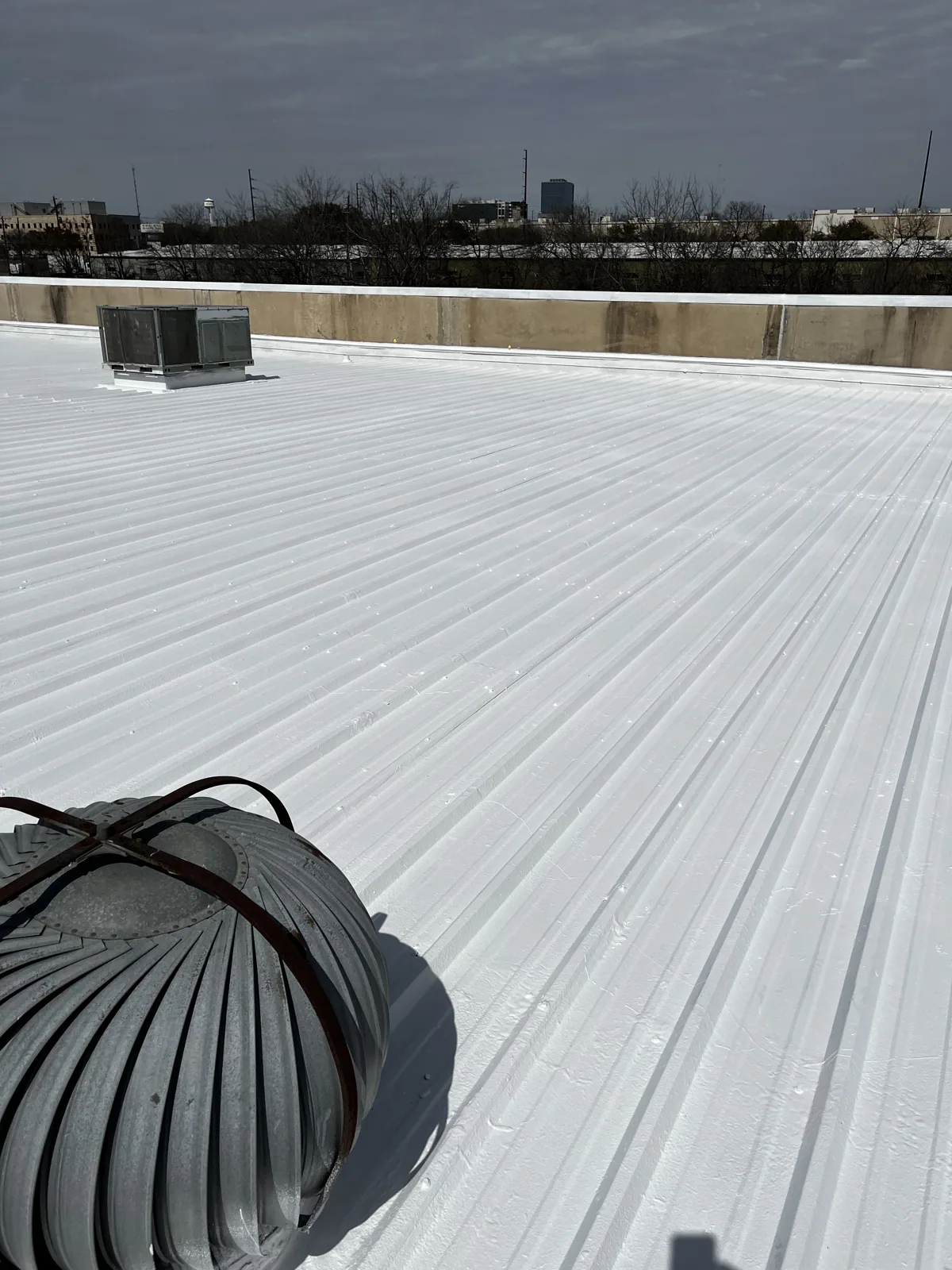
Commercial Roof Coating Restoration in San Mateo, CA
CATEGORY
Commercial Roofing Services
LOCATION
San Mateo, CA
A roof coating is a restoration layer, not a shortcut around a failed assembly. Before recommending one in San Mateo, we inspect the existing surface, seams, penetrations, drainage, and any signs of trapped moisture. The substrate must be stable and suitable for the selected product; loose material, wet insulation, failed attachment, or repeated leaks can change the scope to repair or replacement. The city's code summary sets a two-inch-per-hour minimum rainfall basis for roof drains, so we document outlet and flow conditions before restoration. It does not show whether a given roof drains correctly. For a San Mateo commercial property, the proposal should identify preparation, detail repairs, test areas, and the work boundary before coating begins.
Assembly: identify what the coating will cover
We first determine which roof sections are candidates and what assembly sits below the surface. A property may include modified bitumen, built-up roofing, single-ply membrane, metal, or a previous coating. We check the number and condition of layers where visible, attachment, drainage, exposed fasteners, blisters, splits, chalking, and patches. If plans are unavailable, we identify assumptions and recommend selective testing when the assembly cannot be confirmed from the field. A roof inspection should document those observations instead of treating age or appearance as a coating decision.
City planning lists office and commercial uses in Bay Meadows and Hillsdale Station Area. Those designations give local context, not a roof diagnosis. We record the actual roof zones and work constraints. Where an existing membrane is under warranty, the owner should confirm coating compatibility and approval requirements before work is priced. A silicone coating or acrylic coating is considered only after the existing assembly and preparation needs are known.
Substrate: test the surface before selection
Adhesion depends on preparation, substrate condition, and product requirements. We identify areas that need cleaning, removal of loose material, repair of open seams, or replacement of wet insulation before a test patch is applied. The roof record should note surface type, cleaning method, primer where specified, dry time, environmental conditions, and the test result. If a field patch releases or the surface remains contaminated, stop and resolve the cause rather than coating over it. Product data and manufacturer instructions govern the selected application; a small test area does not certify the whole roof.
Infrared imaging or a core sample can help investigate suspected moisture, but neither should be used to make an unsupported assumption. We map the suspected zones, explain the limits of each method, and obtain owner authorization before destructive testing. If moisture is confirmed, the scope separates removal and replacement from restoration. A moisture survey may help target follow-up openings; a cover-board scope may be relevant when rebuilding a defined area.
Drainage: keep water moving to the outlet
Before coating, we inspect drains, sumps, scuppers, perimeter edges, and changes in elevation. Debris removal may correct a blocked outlet, while a low area or incorrect slope can need a different correction. We note where water remains, whether the membrane is sound around the drain, and how the coating will terminate at strainers, clamping rings, flashings, and overflow paths. Adding a layer at an outlet can reduce clearance if details are not planned. Drain bowls and scupper throats are measured or reviewed against the approved system detail.
The city's shoreline adaptation work reviews infrastructure, land use, and exposure to coastal flooding under sea-level rise. That long-range study does not evaluate an individual parcel or replace a roof-drain inspection; exterior and roof drainage remain separate checks. Where a drain detail is defective, a drain repair should be scoped before coating. We do not use coating thickness to conceal standing water, failed metal, loose flashing, or an unstable substrate.
Roof details: repair transitions before field application
Coating work often turns on perimeter and penetration details rather than the broad field. We inspect wall terminations, curb corners, skylight perimeters, pipe boots, pitch pans, edge metal, and tie-ins to adjacent systems. Each detail needs the repair method and coating reinforcement specified where the product system calls for it. A curb with movement or a loose counterflashing may need mechanical repair before application. We photograph those details, mark them on the roof plan, and separate included repairs from items requiring owner approval.
At a transition between roof types, the new coating must not bridge a movement joint or bury a required termination. We check compatibility, height, drainage, and access for future service. If a roof section has rooftop equipment, the work plan coordinates shutdowns, condensate lines, and technician paths with the facility contact. A curb and support review can define that work boundary. The proposal also states what protection is needed for equipment, intakes, walk pads, drains, and adjacent finished surfaces.
Application: set the application and access sequence
Application planning covers surface preparation, mixing, coverage, wet-film checks, cure conditions, and inspection holds. The crew follows the approved product data for temperature, moisture, and recoat windows. We divide the roof into areas that can be prepared and protected during the available work period. If rain, fog, or dew changes the substrate condition, the schedule may shift; the daily report records why a work area was held. The owner and GC should know who approves a return to application after a weather interruption.
Nearby SFO climate normals are not San Mateo measurements or a daily forecast; application decisions follow current field conditions and product instructions. For an occupied building, a phased work sequence can coordinate noise, odors, access, and equipment use with operations. Material storage, lift locations, fire protection, pedestrian routes, and interior notifications belong in the site plan before mobilization.
Alternatives: compare restoration with repair or replacement
A coating can fit when the assembly is stable, moisture is addressed, and the selected system is compatible. A localized seam or flashing failure may be better handled as a bounded repair. Repeated openings, broad wet insulation, poor attachment, or a deteriorated deck may support a replacement comparison. The proposal should show what the restoration includes, what it excludes, and what field condition changes the recommendation. It should not promise a service life or energy saving that the inspection cannot support.
We compare preparation, detail repairs, reinforcement, coating quantities, access, staging, and required testing. A low initial price can omit the preparation that makes adhesion possible. A broad replacement can include unnecessary removal if no test or condition justifies it. The decision record identifies the observed assembly, moisture questions, approved test areas, compatible product, and owner decision date. If the roof is part of a larger capital program, keep this scope distinct from other buildings.
Closeout: record coverage and future checks
Closeout records should include the areas prepared, repairs completed, product and lot information, application dates, inspection checks, and any sections deferred. The report can include photographs of test patches, transitions, drain details, and final coverage. Note cure limitations or access restrictions that affect inspection. If a detail remains outside the scope, list it as a separate item rather than implying that coating addressed the condition.
For a San Mateo roof, the owner should retain product documents, approved details, maintenance instructions, and any warranty terms supplied by the manufacturer or contractor. Schedule follow-up from the actual system instructions and observed condition. Share plans, prior coating records, and water-entry locations so the crew can define the field scope before application.
Commercial Roofing Questions
Can any commercial roof receive a coating?
No. The substrate, moisture, attachment, surface preparation, compatibility, and drainage determine whether a coating is suitable. Failed or wet assemblies need a different scope.
Does coating repair a leaking drain?
Not by itself. The drain, sump, clamping ring, outlet, and nearby membrane need inspection. A defective drain detail should be repaired and checked before coating work proceeds.
How is adhesion evaluated?
The selected product instructions guide preparation and test patches. The record identifies the substrate, cleaning, primer, conditions, and result; a small test does not certify every roof zone.
Can a coating be installed over wet insulation?
A coating should not conceal confirmed wet insulation. Map suspected moisture and use authorized testing where needed, then scope removal or repair before restoration.
What should a coating proposal include?
It should state the assembly, preparation, repairs, system details, coverage areas, access sequence, testing, exclusions, and approval points for concealed conditions.
Check the assembly before coating
Provide roof plans, prior coating records, known leaks, and access rules. We will document preparation needs and compare restoration with repair or replacement.
Related Pages
- Commercial Roofing in Downtown San Mateo, CA
- Commercial Roof Inspection
- Silicone Roof Coatings
- Infrared Moisture Survey
- Commercial Roof Drain and Scupper Service
- Commercial Rooftop Equipment Curb and Support Roofing
- Commercial Roof Repair
- Commercial Roof Replacement
- Commercial Roofing in Bay Meadows, San Mateo, CA