
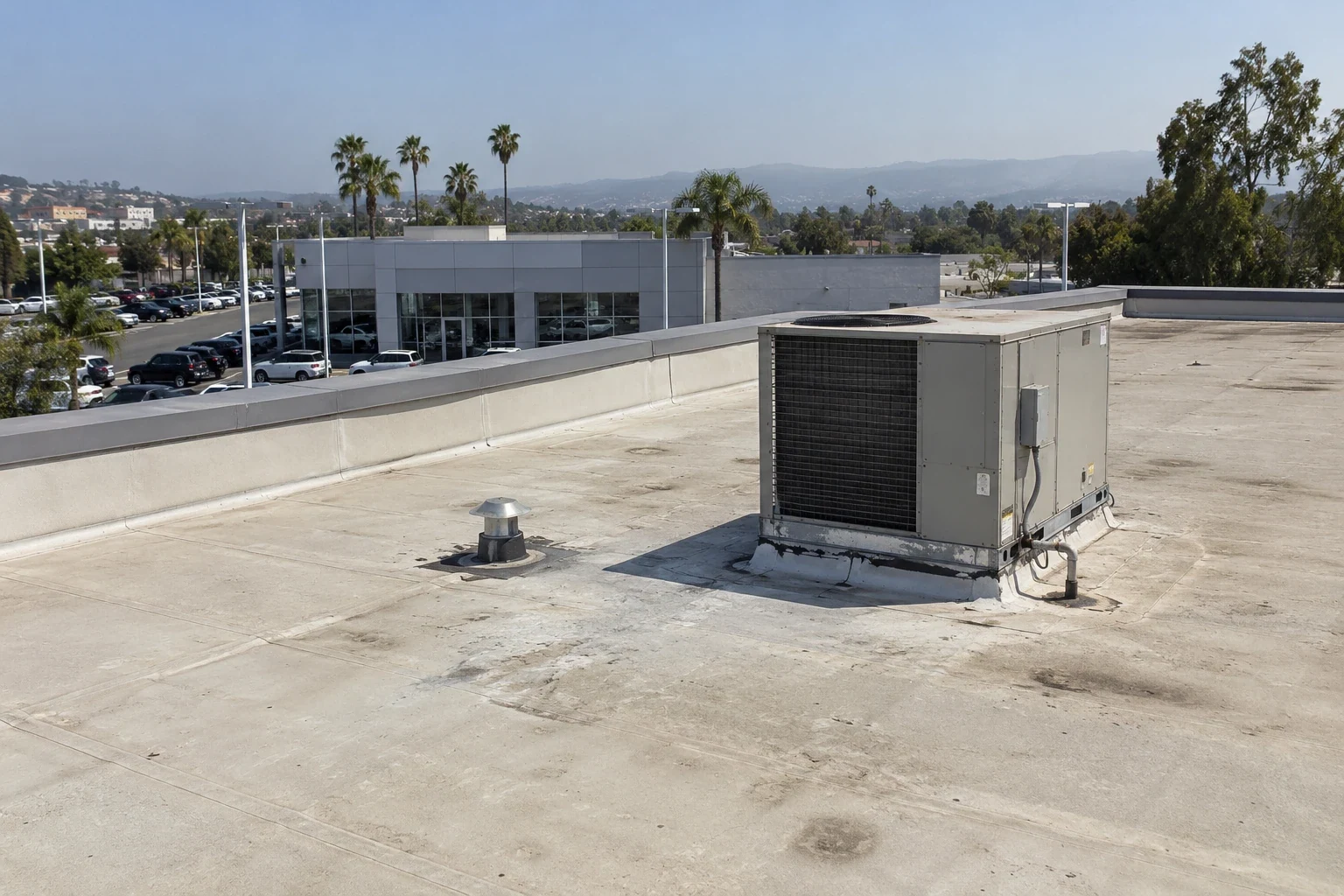
Auto Dealership Roofing in San Mateo, CA
CATEGORY
Property Types We Roof
LOCATION
San Mateo, CA
The showroom floor, service bays, and parts counter do not share the same roof schedule. Showroom and service zones may use TPO membrane systems when the existing conditions support them. A dealership project starts by separating those operating needs from the membrane work above them. San Mateo identifies retailers among its business sectors and names Hillsdale Boulevard and El Camino Real among major corridors. That business context can help the GC understand local circulation, but the actual property layout sets the access route. We inspect drains, penetrations, curbs, roof edges, and any tie-in near equipment, then map how the crew will stage material without interrupting customer parking or service intake. The owner receives a sequence with work hours, protection limits, and a daily dry-in point. If field conditions differ from drawings, the approval process is clear before removal extends into another section.
Separate customer and work routes:
A service lane may need to remain open while crews use a lift, so the preconstruction walk maps vehicle flow from the entrance through customer parking and service intake. Commercial access extends to Hillsdale Station Area. We identify safe staging, overhead clearances, delivery windows, and the route to rooftop access. San Mateo planning names Hillsdale Boulevard and El Camino Real as major corridors, but those roadway facts do not determine how one dealership operates. The manager confirms appointment patterns, inventory movements, and any area that cannot be blocked. A roof phase can then be assigned to a zone above the showroom, service shop, or parts area with matching ground protection below. The GC can coordinate other trades against that sequence, avoiding conflicts between a roof opening and a vehicle delivery. Each workday ends at a named dry-in boundary the facility contact can inspect.
Inspect curbs and penetrations:
Showrooms and service areas may place mechanical equipment, exhaust, conduit, skylights, or sign supports through the roof. We document what is present and how each penetration meets the membrane. The showroom and office interface can be compared with office roof access plans. A loose curb flashing can send water along the roof deck before it appears over a sales desk or repair bay. The survey checks laps, seams, edge metal, drain bowls, and substrate near the reported leak. The owner should provide equipment access rules and identify the trade that can approve shutdowns or disconnection. We record confirmed defects and mark concealed conditions that need a test opening. If a support is moved, its abandoned penetration must receive a complete closure, not only a surface patch. This inspection helps the GC coordinate electrical, mechanical, and roofing scopes so new equipment does not compromise a completed tie-in.
Drainage and code review:
A dealership building can have broad roof areas with several low points, so one blocked outlet may affect a different bay from the reported leak. We trace slope to drains and scuppers, inspect overflow paths, and check membrane transitions at each bowl. San Mateo’s adopted code summary uses a minimum two-inch-per-hour rainfall basis for roof drain design. Before setting the repair limit, arrange warehouse delivery coordination. That local criterion can inform project questions, while the permit team confirms what applies to the actual building. A recover may raise the roof surface and change clearances at drains, parapets, and equipment curbs. We include those height transitions in the scope rather than assume the existing details can simply be extended. Photographs and a roof map show the outlets checked and identify any engineering review needed before installation proceeds.
Choose by field condition:
A small seam failure may be repaired if adjacent material is stable and the substrate supports a bonded tie-in. A wider capital scope may align with roof condition inspection. A recover is possible only after moisture, attachment, and height are checked. Replacement is more sensible if failures recur across the roof or earlier repairs leave too many uncertain transitions. We compare cost drivers such as removal depth, insulation, edge metal, curb work, lift access, and keeping the customer route clear. Different dealership zones may be scheduled separately if the work can be dried in safely at each boundary. The proposal identifies what remains open, what must move, and who approves concealed repairs. A commercial inspection can establish the baseline before the owner approves a larger scope. That gives the GC a record to coordinate with service operations and future equipment work.
Keep the next service call precise:
Closeout photos should show each repaired roof zone, drain correction, curb transition, and tie-in edge. The manager can connect a later leak report to the work map and determine whether it is near a prior repair or in another section. A low-slope system discussion can include replacement phase planning. We record any limitation and maintenance item, including rooftop access by service vendors or future equipment installers. A follow-up inspection after other trades finish helps identify damage before it becomes an interior issue. If the dealership operates in several phases, each phase receives an accepted boundary and its own record. That avoids confusing a protected area with a fully completed one. Share the drawings, access rules, equipment schedule, and leak history; we can return a field scope and sequence that keeps sales, service, and construction coordination in view without assuming all areas can work at once.
A roof phase can be matched to the dealership’s weekly operating calendar so sales and service leaders know where activity will shift. We confirm whether customer parking, vehicle inventory, parts receiving, or service pickup is affected by a lift or staging area. The manager can identify an alternate route before the first delivery arrives. Above the work, the crew marks each curb, drain, and membrane tie-in that needs inspection before it is covered. If the roof opening must stop early, a temporary dry-in point is recorded and checked before the shop closes. At the end of a phase, photographs and a roof map tell the next trade where a vehicle exhaust or mechanical support crosses the assembly. This coordination keeps a later equipment change from undoing completed flashing. It also gives the owner a clear comparison between a repair allowance and the cost of a broader replacement phase.
If customer vehicles or service appointments depend on a particular drive aisle, mark that interface on the staging sketch and set a daily release time with the site contact. Keep the roof work boundary separate from the customer circulation map. At the end of each shift, note the area returned to use and any temporary restriction that carries into the next work window.
Commercial Roofing Questions
Can roofers work while the service department is open?
Often, if the work zone, lift path, and daily dry-in point are planned around service intake and customer movement. The manager identifies restricted hours and the contact for field changes.
What should be inspected around rooftop equipment?
We check curb flashing, pipe boots, support attachments, conduit, and membrane transitions. The owner identifies active systems and the responsible trade before equipment is moved or a shutdown is considered.
Could a dealership roof be repaired by section?
Yes, where the assembly allows stable tie-ins and each area can be protected at shift end. The scope should state the zone, access effect, and interior protection for every phase.
How are drain issues priced?
Drain cleaning, flashing repair, and design changes are different tasks. The inspection records outlet condition and height transitions so the proposal can separate known work from design review.
What does a useful closeout include?
Photos and a roof map should identify repaired zones, curbs, drains, and remaining existing areas. The manager can use that record to coordinate service vendors and later inspections.
Define the roof scope
Share the roof plan, access limits, and recent leak notes for the auto dealership roofing property. We will inspect the field condition, set a work boundary, and coordinate a practical sequence with the owner and GC.